3-Line Summary
- Sudden stress isn’t a failure of willpower—it is an emergency signal from your brain and autonomic nervous system.
- Simple breathing techniques and physical triggers can rapidly lower cortisol, the primary stress hormone.
- Here is a step-by-step recovery routine you can practice immediately right where you stand, with zero prep needed.
“Why Am I So Sensitive Lately?” Were You Blaming Yourself?
Just the other day at work, scheduling got completely tangled, tense words were exchanged, and suddenly my chest felt horribly tight as cold sweat broke out. My fingertips turned freezing cold, my mind went completely blank, and an overwhelming wave of anxiety hit me: ‘If I keep going like this, I’m seriously going to snap.’
On my way home, I obsessively dug through medical papers and research on the autonomic nervous system. And then it hit me! It wasn’t that I lacked willpower or mental toughness. I simply didn’t know how to engage my body’s built-in ’emergency brake.’
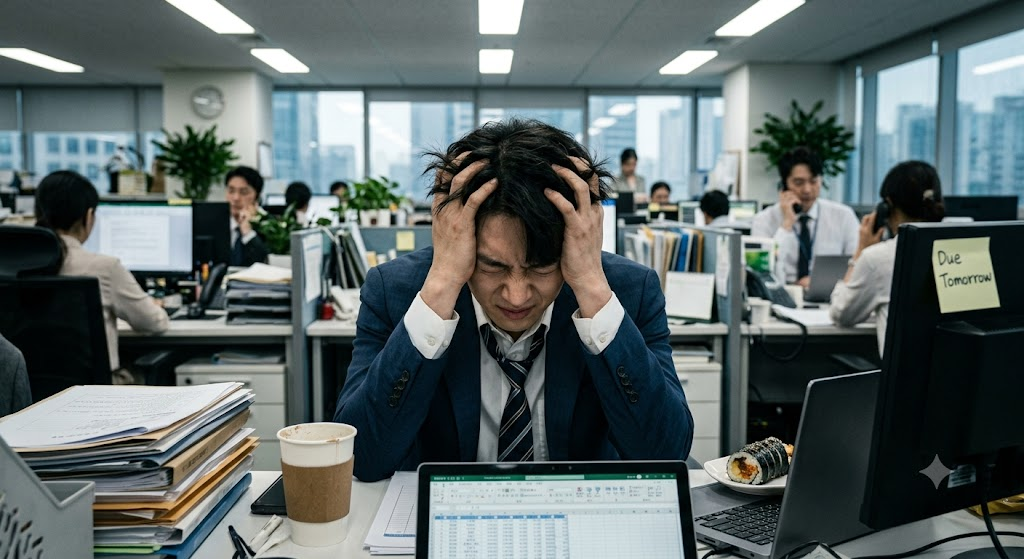
Your Brain Mistaking Stress for a ‘Life-Threatening Danger’
Whenever we experience mental stress, the brain’s amygdala sounds the alarm. It violently kicks our sympathetic nervous system into gear, exactly as if we were facing a wild predator in ancient times. During this reaction, a flood of cortisol and adrenaline pours out, causing your heart to race and your breathing to shallow out.
The real problem is that modern daily stress doesn’t just vanish like a passing predator. Continuous stimulation disrupts the balance of your autonomic nervous system, easily spiraling into emotional exhaustion and burnout.
Luckily, our bodies have a hidden ‘switch’ designed to dial down the sympathetic nervous system and wake up the parasympathetic nervous system. That secret lies in stimulating the Vagus Nerve.

The 3-Step Mental Recovery Routine to Do Right Now
Step 1. Engaging the Brain’s Brake: The ‘Physiological Sigh’ This is the single fastest breathing technique to stabilize your body when stress spikes.
- Inhale deeply through your nose twice in short succession. (Take one deep breath, and without exhaling, take a second quick sip of air to fully expand your lungs’ alveoli.)
- Exhale slowly and fully through your mouth with a long “hnnngh/phew” sound.
- Repeat this just 3 to 5 times. You will feel your racing heart slow down almost magically.
Step 2. Flip the Vagus Nerve Switch with Cold Water This is my personal favorite cheat code when emotions run too high to control. Rush to the sink and wash your hands with ice-cold water, or splash cold water on the inside of your wrists and the back of your neck. This triggers our body’s ‘mammalian dive reflex,’ instantly dropping your heart rate, clearing brain fog, and halting emotional escalation in its tracks.
Step 3. Broaden Your Field of Vision (Panoramic View) When under stress, we experience ‘tunnel vision’—our field of view narrows and our mind gets trapped in a single negative loop. Counteract this by intentionally moving your eyes from side to side, taking in your entire surroundings. Focus on the far corners of the room or a distant horizon; this signals your brain, “Hey, we aren’t in immediate danger right now,” causing it to disarm its alert state.
Common Pitfalls to Avoid (Steer Clear of These!)
There is one critical mistake you must avoid: trying to relieve stress with sweet desserts or extra spicy food.
While highly stimulating foods deliver a temporary dopamine hit that makes you feel good for a split second, they cause a sharp spike and crash in blood sugar. A few hours later, this ‘sugar crash’ leaves you feeling even more fatigued, anxious, and down than before.
When your heart feels heavy, skip the sugary drinks. Instead, sip a glass of warm water slowly while focusing on the physical sensation in your body. It will settle your system much more effectively.

Managing Mental Health Isn’t About Enduring—It’s a ‘Skill’
Please don’t beat yourself up thinking, “Why am I so weak against stress?” You simply haven’t learned the right physical mechanics to respond to the signals your body is sending you.
The routines shared today cost nothing, require no special equipment, and rely on scientifically proven biochemical reactions. If a frustrating moment hits you at work or on your commute today, don’t hesitate—take just three ‘Physiological Sighs’ right then and there. You’ll instantly feel the heavy weight on your chest start to lift!
3. Frequently Asked Questions (FAQ)
Q1. I felt a bit dizzy while doing the breathing exercise. Is that normal?
A1. Breathing too quickly or forcing air in too deeply within a short timeframe can cause temporary hyperventilation, leading to mild lightheadedness. Focus on making your exhalation twice as long as your inhalation, and keep the pace slow, gentle, and natural.
Q2. Whenever I get stressed, my neck and shoulders lock up. Is there a way to release that tension together?
A2. When your sympathetic nervous system fires up, the trapezius and neck muscles automatically tense up. While practicing the breathing routine, shrug your shoulders high up toward your ears as you inhale, and drop them completely as you exhale with a “phew.” Doing this 3 times works wonders for melting away upper body tension.
Q3. Is it safe to practice this routine every day?
A3. Absolutely! These routines don’t rely on medication or artificial stimulants; they simply leverage your body’s natural parasympathetic nervous system. You can repeat them as many times a day as needed without any side effects. In fact, the more consistent it becomes as a habit, the faster your mental recovery speed will be.
4. Related Reads (Internal Link Suggestions)
- [after work 1 hour evening routine]
- [Successful People Daily Routine: A Deep Analysis of the Habits That Drive High Performance]
- [Stop Hitting Snooze: The Ultimate Guide to Building a Morning Routine That Sticks (Backed by Science)]
5. Disclaimer
“This content is provided for informational and educational purposes only and should not be considered professional medical advice, diagnosis, or treatment. Always consult with a qualified healthcare professional regarding any medical condition or treatment plan. Individual results may vary based on personal health status.”