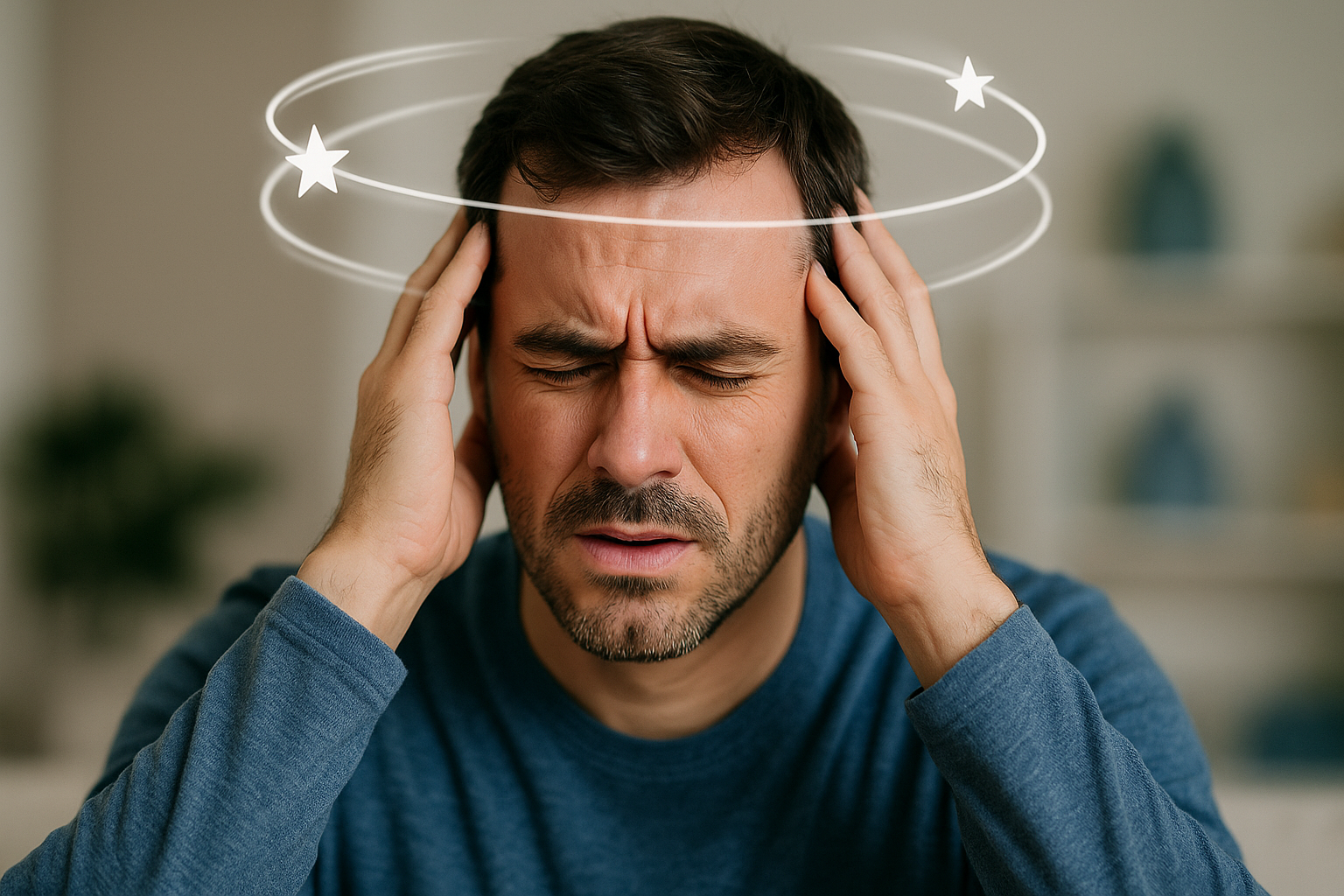
How to Tell What’s Causing Your Dizziness: A Practical, Evidence-Based Guide
Dizziness is one of those oddly vague symptoms. People describe it in completely different ways—some say the room spins, others feel like their body is floating, and some say their legs simply stop cooperating. That’s why in clinical settings, the very first question a doctor asks is quite simple: “What exactly do you mean by dizziness?”
It’s not a trivial question. Different types of dizziness point to entirely different underlying causes, and some of those causes are harmless while others require urgent care.
Today, we’re breaking down dizziness in a way that actually makes sense—based on scientific evidence, major clinical guidelines, and real-world patterns physicians rely on. Think of this guide as a clear roadmap. Follow the trail of clues from your symptoms, and you’ll understand what your dizziness is likely trying to tell you.
Let’s take it step by step, with a calm and natural flow—just like someone explaining it to a friend, but with medical accuracy baked in.
Why Doctors Divide Dizziness Into Four Main Types
For decades, neurologists and ENT specialists have used a four-category system to interpret dizziness. These categories aren’t arbitrary—they reflect different physiological mechanisms and help quickly narrow down dangerous vs harmless causes.
The four types are:
- Vertigo – a spinning sensation, as if the world is rotating
- Presyncope – lightheadedness or feeling like you’re about to faint
- Disequilibrium – unsteady walking or poor balance
- Nonspecific dizziness – vague fogginess, floating sensations, or disconnection
Understanding which category your symptoms fall into is half the diagnosis.
Clinical reviews from Harvard Health Publishing and the Cleveland Clinic repeatedly emphasize that the type of dizziness is often the strongest clue to its origin.
Vertigo: When the World Spins (Most Often an Inner-Ear Problem)
Vertigo is the classic “spinning” dizziness. People often say they feel like they’re on a boat, or the room swirls around them even if their eyes are closed. This type usually originates in the inner ear, which controls your balance.
Common Causes of Vertigo
- Benign Paroxysmal Positional Vertigo (BPPV)
The most common cause—responsible for over 50% of vertigo episodes. - Vestibular neuritis
Inflammation of the balance nerve. - Ménière’s disease
Fluctuating vertigo, hearing loss, and ear fullness. - Central vertigo (brainstem or cerebellar stroke)
Less common but far more serious.
How to Differentiate These
- BPPV:
Sudden, short bursts of spinning (seconds to a minute), triggered by turning your head or lying down. - Vestibular neuritis:
Continuous vertigo lasting hours to days, often severe enough to cause vomiting. - Ménière’s disease:
Spinning + ear ringing + hearing changes. - Central vertigo:
Usually accompanied by neurological red flags.
PubMed studies highlight that central vertigo is frequently misdiagnosed as a benign cause—especially cerebellar stroke.
Reference: https://pubmed.ncbi.nlm.nih.gov/25813536/
Red Flags You Should Never Ignore
- Trouble speaking
- Weakness or numbness on one side of the body
- Loss of coordination
- Double vision
- Inability to walk straight
If any of these show up with dizziness, immediate emergency evaluation is essential.
Presyncope: When You Feel Like You’re About to Pass Out
Unlike vertigo, this dizziness does not spin. Instead, it feels like the world is fading, your vision narrows, or your body suddenly loses power.
Common Causes
- Orthostatic hypotension (blood pressure drops when standing)
- Dehydration
- Low blood sugar
- Anemia (especially iron deficiency)
- Heart rhythm problems (arrhythmias)
- Medications (blood pressure meds, diuretics, antidepressants)
A very typical pattern is:
You stand up quickly → vision dims → knees weaken → sensation passes after a few seconds.
That’s almost textbook orthostatic hypotension.
Serious Warning Signs
- Chest pain
- Sudden shortness of breath
- Palpitations (heart pounding or skipping)
- Actual fainting
In these cases, cardiology evaluation is critical because cardiac syncope can occur without warning and may be dangerous.
Disequilibrium: When Walking Feels Unsteady
This type shows up as difficulty maintaining balance—especially when walking. There is no spinning, no fainting feeling—just instability, drifting to one side, or needing to widen your stance to feel stable.
Key Causes
- Cerebellar stroke
- Parkinson’s disease (early stages)
- Peripheral neuropathy (often from diabetes)
- Vision problems
- Age-related deterioration of balance
- Muscle weakness, especially in the legs
One distinguishing feature:
👉 Disequilibrium typically appears ONLY when walking.
If you sit or lie still, the sensation often goes away.
Cleveland Clinic emphasizes that cerebellar disorders often present subtly—sometimes only as mild imbalance early on.
Reference: https://my.clevelandclinic.org/health/diseases/14739-vertigo
Nonspecific Dizziness: Foggy, Floaty, Hard-to-Describe Sensations
This category often frustrates people because the feeling is vague. It may come as:
- Mental fog
- Floating sensation
- Disconnected or dreamy feeling
- Light fullness in the head
- Uneasy imbalance that doesn’t fit other categories
This type is strongly linked to stress physiology, breathing patterns, and muscle tension.
Common causes include:
Main Sources
- Anxiety disorders
- Hyperventilation (overbreathing)
- Chronic stress
- Poor sleep
- Caffeine overload
- Cervical tension (neck-related dizziness)
- Medication side effects
Few people realize how often the neck plays a role. Cervicogenic dizziness can appear when tight neck muscles disrupt proprioceptive signals. It’s subtle and often not visible on scans.
A PubMed study reports that 28–45% of patients with anxiety disorders experience chronic, vague dizziness.
Reference: https://pubmed.ncbi.nlm.nih.gov/19320344/
Quick Differentiation Guide: Which Type Is Yours?
Here’s a simple practical map:
🔵 Spinning sensation → Inner ear (BPPV, neuritis, Ménière’s)
- Seconds: BPPV
- Hours–days: neuritis
- Hearing loss + ringing: Ménière’s
- Neurological symptoms: consider stroke
🟢 Fainting sensation → Blood pressure, heart, anemia
- Worse when standing: orthostatic hypotension
- Fatigue + pale skin: anemia
- Heart pounding: arrhythmia
🟡 Unsteady walking → Neurological or sensory causes
- Could signal cerebellar issues
- Could be neuropathy
- Could be age-related decline
🔴 Foggy, floating feeling → Stress, hyperventilation, neck tension, sleep deprivation
When Dizziness Is Dangerous (Immediate Medical Attention Needed)
Seek urgent care if dizziness comes with:
- Sudden severe headache
- Difficulty speaking
- Weakness on one side
- Loss of coordination
- Chest pain
- Fainting
- Inability to walk properly
These can signal neurological emergencies or serious cardiac issues.
How Doctors Diagnose Dizziness
Clinicians follow a structured approach:
- Identify the type of dizziness
- Check timing and triggers
- Perform neurologic and vestibular examinations
- Conduct the HINTS test (highly reliable for distinguishing stroke vs inner-ear issues)
- Use MRI only when red flags exist
Interestingly, the HINTS test has been shown to outperform early MRI in detecting stroke in dizzy patients.
Reference: https://pubmed.ncbi.nlm.nih.gov/19741722/
Lifestyle Approaches Based on the Cause
If It’s Inner-Ear Related
- Avoid rapid head movements
- Perform Epley maneuver for BPPV
- Reduce sodium intake for Ménière’s
If It’s Blood Pressure/Heart Related
- Stand up slowly
- Stay hydrated
- Check iron levels
- Monitor heart rhythm if symptoms persist
If It’s Neurological or Balance-Related
- Strengthen lower body and core
- Correct vision issues
- Screen for B12 deficiency
If It’s Stress/Neck Related
- Practice slow diaphragmatic breathing
- Improve sleep routine
- Reduce caffeine
- Add gentle neck and shoulder stretching
Final Thoughts: Your Body Leaves Clues—Learn to Read Them
Dizziness may feel confusing, but it’s remarkably informative once you break it down.
Your body is giving you signals:
- Spinning → inner ear
- Fainting feeling → blood pressure, heart, or anemia
- Unsteady walking → brain or nerve pathways
- Foggy, vague discomfort → stress, breathing patterns, or neck tension
Understanding these distinctions doesn’t replace medical diagnosis, but it gives you a powerful way to understand what your symptoms might be pointing toward.
⭐ Frequently Asked Questions (FAQ)
1. If my dizziness lasts all day, should I worry?
Continuous spinning for hours may suggest vestibular neuritis; but if neurological signs are present, seek immediate help.
2. Does dizziness when lying down mean BPPV?
Short bursts triggered by head movement—yes, that’s classic BPPV.
3. Can fatigue alone trigger dizziness?
Yes—sleep deprivation and chronic stress are major contributors.
4. Can neck tension really cause dizziness?
Absolutely. Cervicogenic dizziness is real, though often overlooked.
5. Should everyone with dizziness get an MRI?
No. Without red flags, MRI is rarely the first step.