Quick Summary
- The ‘Kindling’ for Your Energy Factory: They act as essential enzymes that turn carbs, proteins, and fats into actual fuel.
- The Power of the ‘Complete 8’: B1 through B12 work best as a team; a “complex” form is much more efficient than taking them individually.
- Water-Soluble & Safe: They don’t build up in the body and are excreted daily, so consistent daily replenishment is the key.
“Surviving on coffee alone? Your Vitamin B might be running on empty.”
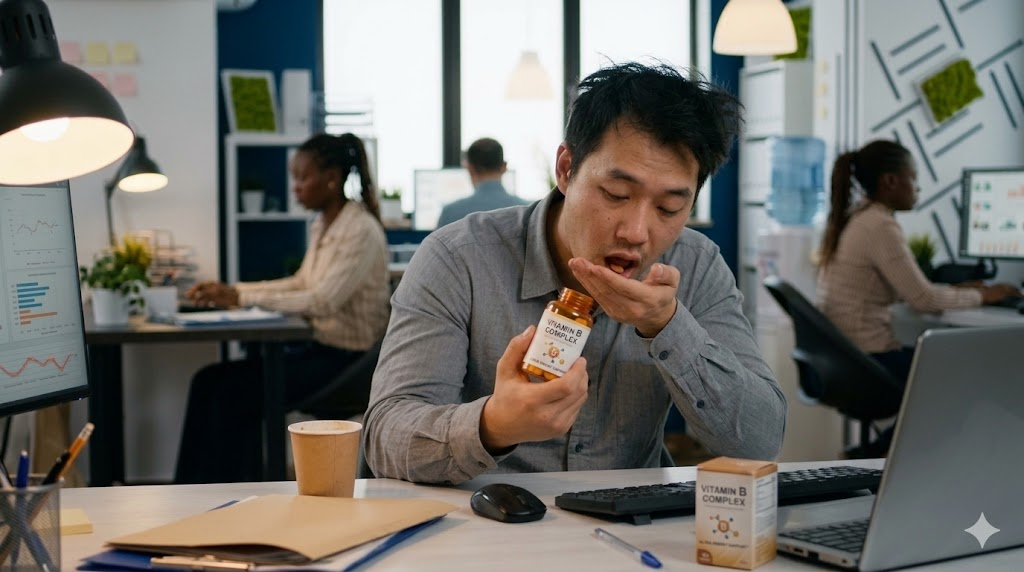
I used to be a total caffeine addict. I felt like my brain wouldn’t even “boot up” without a large Americano first thing in the morning. But while digging through research papers, I had a “Eureka!” moment. According to nutritional guidelines, Vitamin B acts as a vital coenzyme. Without it, the food we eat can’t be converted into energy and just sits there like sluggish waste.
Think of it this way: your body is like a car with a tank full of gas (food), but if you don’t have the spark plugs (Vitamin B), the engine won’t start. That heavy fatigue I felt wasn’t a “lack of coffee”—it was a Vitamin B deficiency.
The ‘8 Siblings’ Working Like a Swiss Watch
Vitamin B only truly earns the name “Complex” when all eight members are present. They each have their own specialty:
- B1 (Thiamine): The ‘Fatigue Fighter.’ It fuels the brain and prevents lactic acid (the fatigue substance) from building up.
- B2 (Riboflavin) & B3 (Niacin): Essential for energy production and protecting mucous membranes. If you get frequent mouth ulcers, keep an eye on these two.
- B5 (Pantothenic Acid): The ‘Stress Protector.’ It helps the adrenal glands produce cortisol, helping us stay calm under pressure.
- B6 (Pyridoxine): Involved in amino acid metabolism and the synthesis of neurotransmitters that keep your mood stable.
- B7 (Biotin): The ‘Beauty Vitamin.’ It’s the “fairy godmother” for the proteins that make up your hair, skin, and nails.
- B9 (Folate) & B12 (Cobalamin): Vital for blood formation and nerve health. Deficiency can lead to anemia or numbness in hands and feet.
Recent meta-analyses in nutritional science suggest that these eight work like an orchestra. They are much more effective when taken together rather than in isolation because they help each other’s absorption.
“When is the best time to take it?” (My Personal Pro-Tip)
After consulting with pharmacists and testing it myself for months, I found that right after breakfast is the sweet spot. Vitamin B boosts your energy, so taking it late at night might make your heart race or interfere with your sleep.
A Quick Word from the Curator! Don’t be alarmed if your urine turns a bright, neon yellow! It’s perfectly normal. It’s caused by Vitamin B2 (Riboflavin). It simply means your body took what it needed and is flushing out the rest. Think of it as a sign that your “internal pipes” are being cleaned!
How to Choose Like a Pro: 2-Step Strategy
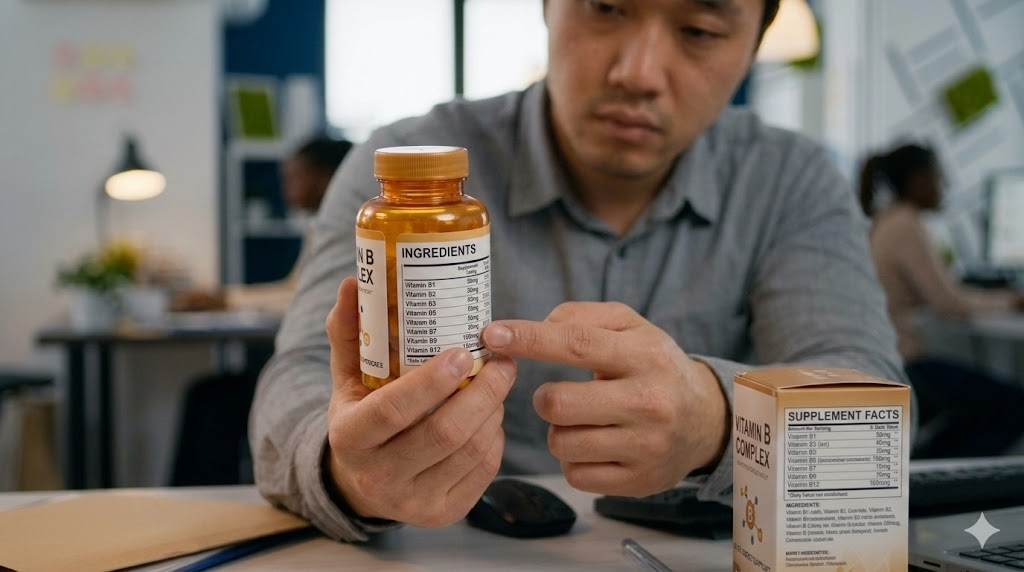
Don’t just go for the most famous brand. Look at the Supplement Facts on the back:
- Check for ‘Active’ Forms: Look for names like Benfotiamine (Active B1) or Methylcobalamin (Active B12). These are “ready-to-work” forms that your body can use immediately.
- Optimal Dosage (ODI): Modern life is stressful and drains B vitamins fast. Instead of just meeting the “Recommended Daily Allowance” (RDA), look for products that offer the Optimal Daily Intake (ODI), which is usually 5 to 10 times higher.
A Few Precautions
Even the best things need a “warning label.” If you have a sensitive stomach, high-dose Vitamin B on an empty stomach can cause “Vitamin Nausea.” Always take it with food! Also, if you have gout or kidney issues, some B vitamins might be taxing, so a consultation with your doctor is a must.
Summary and Conclusion
Now you know the secret of the Vitamin B 8-Siblings!
- Check if it’s a complete 8-type complex.
- Look for active ingredients.
- Take it consistently after breakfast.
Instead of the temporary “jolt” from coffee, try switching on your body’s natural energy engine with a solid Vitamin B Complex. I promise your afternoons will feel a lot lighter!
3. FAQ (Frequently Asked Questions)
Q1. Does taking Vitamin B increase my appetite?
When your metabolism speeds up and your condition improves, you might feel a healthy return of appetite. However, the vitamin itself doesn’t cause weight gain, so don’t worry!
Q2. Can I just take Biotin for my hair instead of a Complex?
Biotin works best when balanced with other B vitamins. Taking only high-dose Biotin for a long time can actually interfere with the absorption of other B vitamins. A complex is always a safer bet.
Q3. Is it okay to take it with my multivitamin?
Since Vitamin B is water-soluble, excess amounts are generally flushed out. However, taking multiple high-dose supplements might cause stomach upset. It’s best to check the total combined dosage.
4. Recommended Reading
- [Biotin vs. Zinc: The Best Combo for Hair Growth?] [LINK]
5. Disclaimer
“This content is for informational purposes only and is not a substitute for professional medical advice, diagnosis, or treatment. Always seek the advice of your physician or other qualified health provider with any questions you may have regarding a medical condition.”
** Clicking on the ad banners helps support this blog and keeps the content coming. Thank you for your support! **