We’ve all been there. You wake up, look at your pillow, and see those stray strands. Or maybe you’re staring at the shower drain, feeling that sinking sensation in your stomach as you clear away a clump of hair. It’s stressful, and frankly, it can feel a bit unfair.
You’ve probably heard the buzz: “Just take Biotin! It’s the miracle cure for hair.”
But let’s be real for a second. Is Biotin really a magic switch for hair growth? Or is it just another wellness trend fueled by clever marketing?
As a health curator, I’m here to cut through the noise. Today, we are going to look at Biotin (Vitamin B7) through the lens of science, not rumors. Here is everything you need to know to make a smart decision for your hair.
1. The Science: Why is Biotin Linked to Hair?
First, let’s look at the biology. Why do hair and Biotin always appear in the same sentence? The secret lies in Keratin.
The Fuel for Your Hair Factory
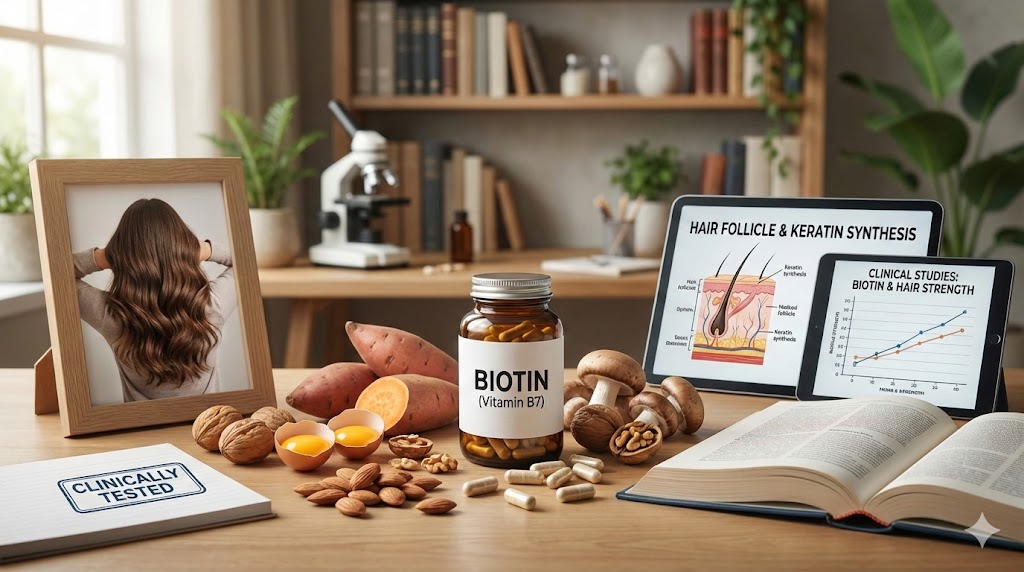
Your hair and nails are primarily made of a protein called Keratin. Biotin acts as a “coenzyme” that helps generate the amino acids needed to build this protein. Think of your hair follicle as a construction site; if Keratin is the brick, Biotin is the skilled contractor ensuring the bricks are laid correctly.
What the Research Says
According to the National Institutes of Health (NIH) and recent dermatological reviews, here is the verdict:
- If you are deficient: A lack of Biotin will cause hair thinning and loss. In these cases, supplementation works wonders.
- If you are healthy: Biotin isn’t necessarily a “growth serum” that creates new hair follicles from nothing, but it plays a crucial role in strengthening the hair shaft. It helps prevent breakage, making your hair look fuller and thicker over time.
Key Takeaway: Biotin acts more like a “strengthener” for existing hair rather than a “fertilizer” for bald spots.
2. How to Take It: Dosage & Best Practices
“More is better,” right? Not exactly. While Biotin is water-soluble (meaning excess is flushed out), mega-dosing blindly isn’t the smartest strategy.
① How much do I need?
- The Standard: The adequate intake for adults is only 30 mcg per day.
- For Hair Goals: Most hair supplements contain anywhere from 1,000 mcg to 5,000 mcg. While safe for most, you don’t need to go overboard with 10,000 mcg unless advised by a doctor. A range of 2,500–5,000 mcg is commonly cited in successful case studies for hair quality.
② Timing Matters
Since Biotin supports energy metabolism, take it with a meal to aid absorption and prevent stomach upset.
- Best time: After breakfast or lunch.
- Pro Tip: Taking it on an empty stomach might cause mild nausea for sensitive stomachs.
③ The “Synergy” Effect
Biotin hates to work alone. To maximize absorption and efficacy, look for these partners:
- Brewer’s Yeast: A natural, rich source of B-vitamins.
- Zinc: Essential for hair tissue growth and repair.
3. ⚠️ Safety Warning (Crucial: Read Before Your Next Doctor Visit)
This is the most important section of this post. While Biotin is generally safe, there is a serious interaction that the FDA has issued an official warning about.
Stop Biotin Before Blood Tests!
High levels of Biotin in your blood can interfere with lab test results, leading to false diagnoses.
- Heart Attacks (Troponin): Biotin can cause falsely low results for troponin, which is used to diagnose heart attacks. This is dangerous.
- Thyroid Tests: It can mimic the results of Graves’ disease (hyperthyroidism).
Editor’s Advice: If you have a health check-up or blood draw scheduled, stop taking your Biotin supplement 3 to 7 days beforehand. And always tell your doctor, “I am taking a Biotin supplement.”
The “Acne” Debate
Some users report breakouts (cystic acne) after taking high-dose Biotin. This happens because Biotin competes with Vitamin B5 (Pantothenic Acid) for absorption. If you break out, try lowering the dose or taking it alongside B5.
4. How to Choose a Quality Product
Don’t just buy the bottle with the prettiest label. Check the “Specs.”
- Source Matters: Look for naturally derived Biotin (often from dried yeast) rather than purely synthetic versions for better bioavailability.
- Check the Blend: A good hair supplement shouldn’t just be Biotin. Look for a complex that includes Zinc, Selenium, or L-Cystine.
- No Nasty Additives: Check the “Other Ingredients” list. Avoid unnecessary chemical fillers like Silicon Dioxide or Magnesium Stearate if possible.
5. Conclusion: Patience is Key
Biotin isn’t a magic wand. You won’t wake up tomorrow with a mane like a lion. However, it is one of the most science-backed nutrients for building the foundation of strong hair.
If you are struggling with weak, brittle hair, give Biotin a try for at least 3 to 6 months. Combine it with a protein-rich diet, and you will likely see a difference in the mirror.
Here’s to your healthier, stronger hair journey!
💡 FAQ: You Asked, We Answered
Q1. Will Biotin make hair grow on my face or body too? A. This is a common myth! Biotin supports the health of existing hair follicles; it does not change your genetics or hormones to sprout new hair in unwanted places.
Q2. Can I take it with Finasteride or Minoxidil? A. Yes, absolutely. They work via different mechanisms. Finasteride targets hormones (DHT), while Biotin provides nutritional support. They can be a powerful team.
Q3. How long until I see results? A. Hair grows slowly (about half an inch per month). You typically need to wait 90 days to see visible changes in hair thickness and nail strength.
📚 References & Official Sources
We believe in science-backed information. Below are the direct links to the official warnings and studies cited in this article.
- FDA Safety Communication (Crucial):
- The FDA Warns that Biotin May Interfere with Lab Tests
- Source: U.S. Food and Drug Administration
- NIH Fact Sheet (Dosage & Standards):
- Biotin – Fact Sheet for Health Professionals
- Source: National Institutes of Health (Office of Dietary Supplements)
- Clinical Review on Hair Loss:
- A Review of the Use of Biotin for Hair Loss (Patel et al., 2017)
- Source: Skin Appendage Disorders (via NCBI)
[Disclaimer] The content provided in this article is for informational purposes only and is not intended as medical advice, diagnosis, or treatment. Always consult with a qualified healthcare provider before starting any new supplement regimen, especially if you have underlying health conditions.