[The 3-Second Summary] For the Busy Reader
- Timing: Never on an empty stomach! Take it in the middle of a meal, not just “after.”
- Ingredients: Swap synthetic forms for “Active Forms” (Look for words starting with ‘Methyl-‘ or ‘P-5-P’).
- Dosage: More isn’t always better. If you have a sensitive stomach, skip the high-dose ‘Megadoses’ and stick to 25~50mg.
“I Wanted Energy, But I Just Got Nausea…”
Have you ever popped a Vitamin B complex first thing in the morning, thinking, “Let’s crush this day!” only to find yourself on the commute feeling like your chest is on fire? or perhaps fighting back a wave of nausea that ruins your appetite for lunch?
I’ve been there. I once bought a popular, high-potency Vitamin B complex from overseas because everyone said it was a “game-changer” for fatigue. Within three days, it was banished to the back of my drawer. I thought my stomach was just too weak.
But I was wrong. It wasn’t my stomach’s fault—it was the ‘Form’ and the ‘Timing’.
If you are a “sensitive stomach owner” like me, you don’t have to live with fatigue just to avoid the pain. Today, as a picky health curator, I’m going to break down exactly how to take Vitamin B without the gut-wrenching side effects.
Why Does Vitamin B Hate My Stomach?
It’s not just you. Vitamin B supplements, specifically B1, B2, and B6, are naturally acidic or can generate gas during digestion. When you drop a highly concentrated pill into an empty stomach, it’s like setting off a tiny chemical bomb against your delicate stomach lining.
Plus, let’s be honest about the smell. That distinctive “yeasty” odor (often from B vitamins) can trigger a gag reflex or make nausea worse if it regurgitates.
Wait! Is it the Niacin (B3)?
If your product has a high dose of Niacin (Vitamin B3), it can cause a “flush” (red, tingling skin) and spike stomach acid production. Always check the label if you feel a burning sensation.
Step 1: The “Sandwich Method” & Timing
Before buying new supplements, let’s try fixing how you eat them. This costs zero dollars.
① Don’t Just Eat “After”—Eat “In Between”
Most people think “30 minutes after a meal” is the rule. For us with sensitive tummies, that’s too late. I personally tested various timings, and the winner was the “Sandwich Method.”
- Eat half of your meal.
- Take the supplement.
- Finish the rest of your meal.
This buries the pill in the food, preventing it from touching your stomach lining directly. It mixes with the digestive enzymes naturally, significantly reducing irritation.
② Pair with Protein & Fat, Not Just Carbs
A banana or a quick latte isn’t enough buffer. Stomach acid regulates itself better when protein enters the system. Taking your vitamin with a solid meal containing eggs, meat, or tofu is much safer than taking it with a light, carb-heavy snack.
Step 2: Switch to “Active Forms” (Read the Label!)
If changing your timing didn’t help, the problem is likely the pill itself. Forget the fancy brand names; we need to look at the Ingredient List on the back.
① Ditch “Inactive,” Choose “Active”
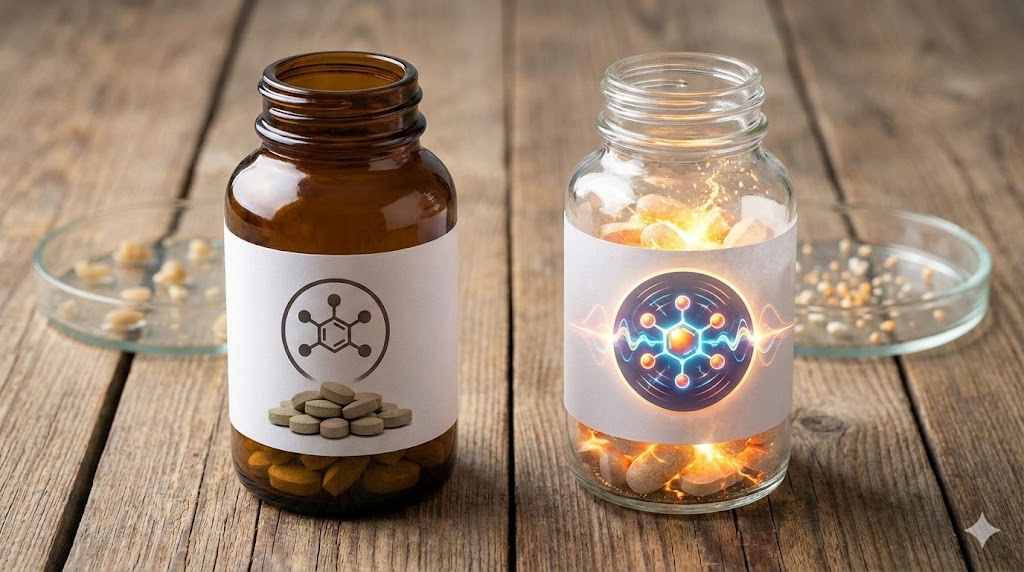
This is the most critical part. Cheaper Vitamin B complexes often use “inactive” or synthetic forms. Your body has to work hard to convert these into a usable state. For people with slower metabolisms or sensitive guts, this conversion process creates burden and gas.
“Active Forms” (Coenzymated forms) are already prepared for your body to use. They absorb faster and don’t hang around in your gut causing trouble.
[The Cheat Sheet for Your Shopping List]
- Vitamin B12: Avoid ‘Cyanocobalamin’ ❌ -> Look for ‘Methylcobalamin’ ⭕
- Vitamin B6: Avoid ‘Pyridoxine HCl’ ❌ -> Look for ‘Pyridoxal-5-Phosphate (P-5-P)’ ⭕
- Folic Acid (B9): Avoid ‘Folic Acid’ ❌ -> Look for ‘Methylfolate (5-MTHF)’ ⭕
If you walk into a pharmacy or health store and ask for “Methylated B Complex” or “Active B Complex,” they will know exactly what you need.
② Lower the Dose (Beware of Overdose)
Those popular “B-100” or “Mega-Dose” products are great for iron stomachs, but risky for us. Even though Vitamin B is water-soluble and “flushes out,” the journey before it flushes out can be painful.
Choosing a product with a moderate dosage (like B-50 or even lower) and taking it twice a day is much smarter than dropping a high-dose bomb on your system all at once.
My “Trial and Error” Conclusion
After nearly going to the ER thinking I had an ulcer (when it was actually just a B-Complex pill stuck in my esophagus), I learned a valuable lesson: “The best supplement isn’t the one with the highest numbers, but the one you can take consistently.”
If your current bottle makes you dread the morning, toss it. Don’t feel guilty. Switch to an active form, lower the dose, and use the sandwich method. Surprisingly, I felt more energized with a lower dose because I wasn’t skipping days due to stomach pain.
Your gut health matters just as much as your energy levels. Be kind to your stomach!
3. FAQ (Frequently Asked Questions)
Q1. Can I take Vitamin B at night?
A. It’s generally recommended for breakfast or lunch. Vitamin B boosts energy metabolism, which can act like a mild stimulant. Taking it late might keep you awake. However, if your dinner is your biggest, most “cushioned” meal and you have severe stomach issues, you could try it at dinner—just monitor your sleep quality.
Q2. Doesn’t taking it mid-meal ruin the taste of my food?
A. It can if you let it sit! The trick is speed. Right before you swallow a bite of food, pop the pill in, take a sip of water, and swallow. Then immediately follow up with another bite of food. You get used to it quickly.
Q3. Can I break the tablet in half to reduce the dose?
A. Be careful. If it’s a “Time-Release” or “Enteric Coated” tablet, breaking it destroys the mechanism and might cause more irritation or reduce absorption. Unless the tablet has a score line (a little groove down the middle), it’s better to buy a lower-dose product.
4. Recommended Reading
- [Related Post] How to Eat Omega-3 Without the Fishy Burps (rTG vs. Plant-based)
- [Related Post] Magnesium Types Explained: It’s Not Just for Eye Twitches
5. Disclaimer
“This content is intended for informational purposes only and does not substitute for professional medical advice, diagnosis, or treatment. Always seek the advice of your physician or qualified health provider with any questions you may have regarding a medical condition. Individual results may vary.”